Every time your car glides over a speed bump or holds steady through a sharp corner, the suspension system is doing its job. It is one of the most important mechanical systems in any vehicle, yet most drivers never think about it until something goes wrong. The suspension connects the wheels to the body of the car, absorbs shocks from the road surface, maintains tyre contact with the ground, and allows the driver to steer accurately. Different vehicles have different demands, which is why several distinct suspension designs exist. Here are the most important ones explained.
MacPherson Strut
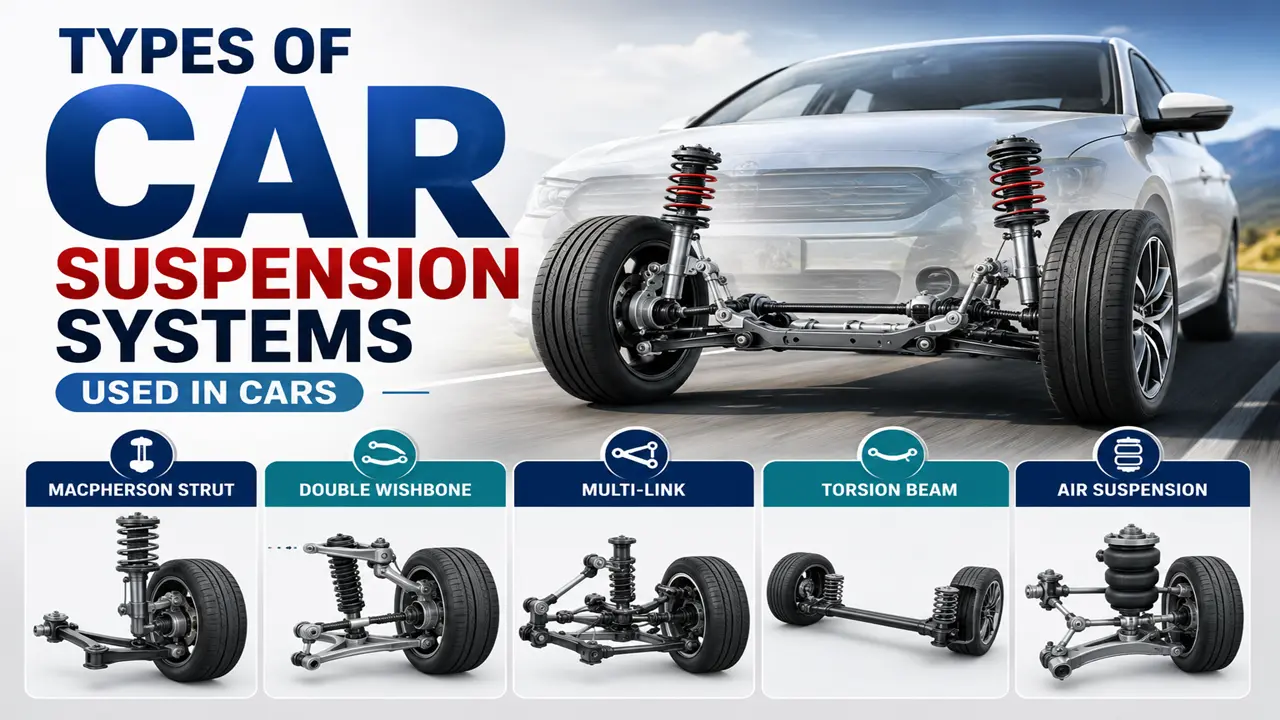
The MacPherson strut is the most widely used suspension design in the world. Invented by Earle MacPherson at Ford in the 1940s, it combines a coil spring and a shock absorber into one compact unit called a strut, which connects the wheel hub to the car body. A single lower control arm holds the bottom of the assembly in place.
Its popularity comes down to simplicity. Fewer parts mean lower manufacturing cost, less weight, and easier repairs. The drawback is geometry — as the wheel moves over bumps, the camber angle shifts, reducing tyre grip during hard cornering. For everyday driving, this is an acceptable compromise, which is why the Toyota Corolla, Honda Civic, Volkswagen Golf, and Maruti Suzuki Swift all use MacPherson struts at the front.
Double Wishbone
Double wishbone suspension uses two A-shaped control arms — one upper and one lower — to locate each wheel. The upper arm is shorter than the lower, and this deliberate geometry keeps the tyre more upright during cornering, maximising the grip available. The spring and damper are mounted separately, giving engineers more freedom to tune comfort and handling independently.
The result is noticeably better handling and more precise steering feel than a MacPherson strut. The penalty is cost — more components mean higher prices and more to service over time. Double wishbone is therefore found on performance cars and premium vehicles: the Porsche 911, BMW 3 Series, Honda Civic Type R, and in the Indian market, the Hyundai Creta and Kia Seltos both use this design at the front for superior ride composure.
Multi-Link Suspensio
Multi-link suspension uses three to five separate arms to control each wheel, with each arm managing a specific type of force — lateral, longitudinal, or vertical. By separating these forces, engineers can tune ride quality and handling almost independently of each other. A well-set-up multi-link rear suspension can also generate passive rear-wheel steering, causing the rear wheels to subtly angle inward during cornering to stabilise the car.
This is the most sophisticated passive suspension design in common use today. It delivers the best balance of ride comfort and handling available without electronic intervention. The Mercedes-Benz C-Class, Audi A4, Tata Safari, and Ford Mustang all use multi-link at the rear. The trade-off, as always, is complexity and cost.
Solid Axle
A solid axle connects both wheels on an axle with a single rigid beam. When one wheel hits a bump, the movement is transmitted to the other wheel. This makes it less comfortable on normal roads but enormously strong and durable. It is simple to build, cheap to repair, and capable of handling heavy loads and rough terrain without breaking.
The Jeep Wrangler retains solid axles at both ends as a deliberate engineering choice for maximum off-road capability. The Mahindra Thar uses a solid rear axle for the same reason. Most commercial trucks and the Toyota Hilux rely on solid rear axles for their load-carrying strength.
Air Suspension
Air suspension replaces the conventional steel coil spring with a pressurised rubber air bag. An onboard compressor adjusts the air pressure to raise or lower the car and change its ride stiffness automatically or on driver command. The same vehicle can ride softly in the city, firm up on the highway, and raise itself on rough tracks — adaptability no passive spring can match.
The downside is cost and reliability. Compressors and air bags are expensive to replace. Air suspension is therefore reserved for flagship vehicles: the Mercedes-Benz S-Class, Audi A8, Range Rover, Rolls-Royce Ghost, and Tesla Model S all feature it as standard or optional equipment.
Conclusion
Each suspension type is a deliberate answer to a specific set of demands. MacPherson struts keep everyday cars affordable. Double wishbone and multi-link deliver the precision that performance and luxury cars demand. Solid axles endure conditions that would destroy more refined setups. Air suspension adapts to whatever the road requires. The system underneath your car shapes everything about how it feels to drive — understanding it helps explain why some cars feel planted and confident while others feel vague and disconnected from the road.